Monday, March 25, 2013

Spring Visitors and Palm Sunday


My weekend guests entertain the local kids.

As I found out at the end of February (when the country director came to visit my site) it is fun to host visitors, even if just for the day. So this past weekend was even more exciting because several volunteers came to visit for the four-day weekend! March 21st is Human Right’s Day, a national holiday in South Africa and a day off from school, and since it was on a Thursday, we were given Friday off as well. It seemed like the perfect time to get together with friends who live both near and far, and best of all, I didn’t have to do any of the traveling, just the hosting.

The two volunteers who were coming in from Northern KZN made great time (traveling by taxi on holidays is actually the easiest time to travel), and I and three other volunteers in my area were able to meet them in town by late afternoon. We shopped for groceries and the like and then headed to my site for a few days of catching up and sharing stories of our service. The two most surprising things about the visit (and the reason I mention it at all) were that my host family was far more excited than I was to have people visit and my visitors were far more excited that I have ever been about not having electricity.

Out and about visiting the area.
I’m not sure if the volunteer before me had guests on a regular basis, but at this point, I really have not. Mostly because I don’t like messy people coming over and cluttering up my house (and PCVs seriously seem to be the messiest people in the world.) But when I asked my host family if it was okay to have visitors for a couple of nights, they were more than happy to hear the news. They brought out tons of extra blankets and kept offering me pots and pans and dishes and glasses to use while my friends were here. The blankets were definitely a plus, but everything else I pretty much had covered, so I told them not to worry and I continued to reassure them that if we needed something, I wouldn’t hesitate to ask. The first evening, the six of us spent time playing outside with the neighborhood kids and when it got too dark, we moved inside to play cards for a little while before they headed home and we made dinner. The next day, we walked / taxied to visit another volunteers site, so that our guests could see as much of the area as possible. It was interesting to hear their perspective on how different this area of the country was from theirs. Not long after we returned from the day’s travels, my host sister knocked on my door and asked to speak to me. Before she said anything else, I completely panicked and wondered what we could have done in the last twenty-four hours that would have been offense. Turns out that my host family was hoping that we would all come over to their house that evening and that one of the volunteers would bring the guitar I have and play for them. No problem there, as long as I was not the one expected to be playing the guitar. After a fun-filled few days, everyone left on Saturday morning (unfortunately, with not as much luck traveling home) and it was back to just me. Thankfully, the mess that was left behind was minimal, so I guess I’ll give hosting a try again soon.

Palm Sunday tradition: A boy rides a donkey to church.
Then, yesterday morning, I surprised my family again by announcing that, if possible, I would like to accompany them to church, since it was Palm Sunday. I’m pretty sure that they considered this a miracle unto itself. (I have most definitely never shown the slightest interest in church since my arrival.) They said that it was not problem and that they were sure that everyone at the church would be extremely excited to see me there. I sort of figured that, but I requested that we still try to make my attendance as low-key as possible. My host sister said it shouldn’t be a problem and that I could just sit in the back, and if I got bored, I was welcome to go home. On a normal Sunday, the Zion church service that they attend lasts approximately three hours, so on Palm Sunday I couldn’t even imagine how long things would go. Getting bored was nearly guaranteed, but I told my host sister that I was sure I would not want to leave.

The procession on the way to the church.
The church is in another part of the village and about a twenty-minute walk away. But since it was Palm Sunday, we started by meeting the rest of the congregation on side of the road and then walking (and singing and drumming) to the church together led by a boy on a donkey. When I arrived at the meeting point with my family, there was a LOT of handshaking and smiles from the gogos (grannies) in the village who were pleased to see that I was joining them for the service. My host my mom was clearly very proud of the fact that I was there that day. The actual church is a small, one-room building with benches along the perimeter and a raised platform with an altar table at the front for the three service leaders. There was quite a bit more greeting and handshaking as I made my way to the door of the church, and when the priest (or whatever the leader is called) saw me enter, a chair was found, put in the front, and I was led to sit in it – for the entire three-hour service. The very definition of low-key.

The one room church on the other side of the village.

The church leaders prepare at the altar before the mass.

A view of the congregation from the front altar.
Most of the actual service was a blur. Lots of Zulu, obviously, although occasionally one of the leaders would look at me and say something in English. For that reason alone, I tried my best not to fall asleep; a major challenge in the rather warm room! There was a reading from the bible followed by comments from church leaders and church elders. Comments is not really the right word – more like extreme praising of the Lord – none of which I could not understand, but I nodded my head and said “amen” as often as possible. Lots of standing, sitting, standing, sitting, like Catholic mass. Approximately a thousand songs were sung, a few of which I knew from morning assembly at school. Several times different groups of kids danced in circles or waved large sticks at each other – I had no idea what that was about. A very long time was taken for the “money collection” part of the service. From what I could gather, if you were going to make a donation, you came up to the front and made a very long speech about what a sacrifice you were making and thanked many people and then put your donation (normally R2 about US$0.20) in the basket. I was asked to say a few words, so I tried to thank everyone and say how happy I was to be welcomed to the church on such an important day. But really, I don’t know if anyone understood my broken Zulu or not. When I finished, something was done with tall, leafy stalks that definitely represented the “palms” part of Palm Sunday. By something, I mean a little water was sprinkled on them as they appeared to be blessed and distributed. And then everything just ended. No closing song, no procession out the back door, just finished. Surprise, you get to go home now! Oh, did I mention that everyone left their shoes outside the door and we were all barefoot the whole service? There was that, too.

Overall, an incredible experience. Not one that I plan to repeat any time soon, but I’m very glad I went, and I’m certain that I’ll give it another go again before I leave.

Monday, March 18, 2013

Geordie Shore


This past weekend I and two other PCV friends had the rare opportunity to watch a little South African television (no reason to go into the details of how or where, let’s just say it was a “first world” weekend). The main event was a Six Nations rugby match (a sport that I know absolutely nothing about) but when it was over, we had a chance to do a little channel surfing. Now, to be honest, I was too cheap to pay for cable in the States, so suddenly being able to choose from about 100 channels when I haven’t had access to TV in about 8 months was more or less sensory overload. I only managed to watch one or two extra shows and the beginning of the most recent Mission Impossible movie before realizing that I just couldn’t watch anymore. But it did remind me that I have not actually given any info on the little bit I know about television here.

South Africa has four major channels that broadcast to televisions for free: SABC 1, SABC 2, SABC 3, and eTV. One of them, (I think SABC 3) broadcasts only programs in English, whereas the other three mix programs in nearly all of South Africa’s 11 official languages. On these channels is where you can watch the some of the most popular evening “soapies” “Generations,” “Rhythm City,” and “Scandal,” as well as the news, game shows, documentaries, national sports events, and a variety of other programs that wouldn’t look that unusual to an American viewer. Should you be willing to pay for satellite TV, just like in the US, a whole new world of programming is available: channels exclusively in certain languages, sports channels, movie channels, cooking channels, etc. And as it turns out, South Africans enjoy quite a few programs from both the US and the UK. Tragically, among these is the MTV reality show “Jersey Shore.” Even more tragic is that MTV decided to make a UK version of this show called “Geordie Shore” and as unbelievable as this may seem, it is even more ridiculous than the original. The nine cast members are all from the Newcastle area and live at a house on the beach. I happened to watch an episode where they were sent to Cancun to enjoy Spring Break (with a mostly American college crowd) and then maybe stay the rest of the season – I don’t know, as I was too distracted at all the British slang that I could not understand. Anyway, I’m sure it’s possible to find this show on the internet, so if you want to see the Jersey Shore get out-“Shored,” give it a look. You won’t be disappointed. Otherwise, I was hoping to see an episode or two of “The Daily Show” or “The Colbert Report” but unfortunately, the owner of the television did not happen to be a fan of either, so there were no episodes recorded on his DVR. He did, however, say those shows are in fact broadcast in SA on a comedy channel, which is good to know for my next trip to the “first world.” Until then, I can rest assured that while I am without TV for these two years, I’m really not missing a thing.


Monday, March 11, 2013

Teaching Time


I can’t remember the last time I had such a complete epic fail as my past week of teaching Grade 5 Maths. It is quite possible that not one learner obtained any new knowledge this entire week. I might was well have tried to teach them how to find the derivative. What daunting topic was I actually trying to teach? Time. Writing down an am or pm time that was said verbally (like I said twenty past 4 in the afternoon). Writing down an am or pm time that they saw on a clock face. Writing down an am or pm time that they saw on a digital 24-clock. Didn’t think it would be that difficult – review really. Totally wrong.

When they heard a time said aloud verbally, they were completely confused as to which number was the minutes and which was the hour. The words “past” and “to” (as in quarter to three or half past eleven) were simply interchangeable and did not seem to mean different things, or really they didn’t seem to mean anything at all. While looking at a clock face they were unable to distinguish between the hour and the minute hand. And when faced with a digital time, they would simply write in again and then randomly put an am or pm (or both) after the time. And in the rare case that none of above offered a challenge, they often wrote something like 2:8pm, forgetting that the minutes always needed two digits. Worst of all, my real goal for the week was to have them learn how to calculate the amount of time that had passed between two given times and to determine the ending time of an event given the start time and the amount of time that would pass until the end. It didn’t take long for me to realize that there was a zero percent chance we would get to that at any point.

So why such an uphill battle? I’m sure that there’s a different reason for every learner, but I can’t help but think that a big part of it is the relative importance (or lack of importance) of time in general in Zulu culture. Some of the problems are similar to those faced in America. Very few people wear watches any more, so the number of times most of the kids have seen a clock face is extremely limited. But these are not kids with cell phones. Most likely there is a cell phone for use by the family, often to send and receive text messages, but it is not checked regularly for the time of day. So it is easily possible that the learners could go for days without ever seeing the time in any fashion. And why should they? Time is of no consequence here. If it is said that an event will begin at 11am, you are lucky if anyone arrives by 1pm. What time does the next taxi leave for Durban? When it fills up with people. When does my class start? When the teacher teaching the class before me is finished. These are the realities of the culture, so time becomes just another one of those maths concepts that beg children to ask “When am I ever going to use this?” I’m not going to lie; it’s frustrating.

And so now the task has doubled – or maybe quadrupled. I must find a way to make time seem important to kids that don’t have access to television, so TV program schedules don’t offer much interest and to kids that aren’t likely to be headed to the airport anytime soon to catch a plane and to kids that cook by taste and sight rather than recognizing how long something has been boiling. (I once asked my host sister how long it took to boil a butternut and she said until it is soft to the touch. When I asked again about how long that usually takes, she simply said she had no idea, she never thought to figure that out as it is just even enough to check every once in a while to see if it is done.) And I must go back to the teaching schedule and find the time to re-teach this topic. This is one of those moments when a time machine would really come in handy. 

Monday, March 4, 2013

Six Months In and A Fresh Start


Happy 6th Month Anniversary to me! Hard to believe, but I swore in on September 2, 2012 and arrived at my site just one day later. So 25% of my service has been completed already! There is no explaining where the time has gone; in so many ways I feel like I just arrived.

It has not escaped my attention that in my first six months I have not kept up with my blog…at all…in words or pictures. But with 18 months to go, there is still plenty of time for me to tell a few stories of my adventures teaching grade 5 maths, library use, and basic computer skills in rural South Africa. And since I finally bought a new camera, I may even try my luck at uploading some pictures.

So here’s a quick six-month recap. I arrived in September 2012 to a cold and rainy spring, which made me think I was not necessarily cut out for “the Peace Corps life.” But I stuck it out, and with the help of my host family and teachers, I got to know my primary school and community during the last term of 2012. For the most part, my days were spent visiting neighbors, re-organizing the school’s library, and observing classes and activities at the school. In those first three months, I also figured out the big things: like how to live without electricity (solar panel) and how to deal with boredom (crossword puzzles and a Rubik Cube). And I adjusted to the small things: like how to walk to school through the mud (rain boots) and how to dispose of trash (burn everything). When December finally arrived, I was reunited with my fellow volunteers for a two-week In-Service Training before traveling around Lesotho and southern KwaZulu-Natal for “summer vacation”. I arrived back at my site just in time to ring in the New Year, and rested up for the start of the school year in mid-January. The last month and a half have been filled with the normal ups and downs of teaching primary school, as well as a few side trips to see fellow volunteers and explore South Africa. I was fortunate enough to attend an international soccer game (South Africa v. Mali) in Durban in early February. And just last weekend, I traveled to Pretoria to start working on a committee that organizes resources for current and future PCVs in South Africa. Just when I was starting to think I hadn’t done anything since I had been here!

As school is in full swing, I suspect that most of my upcoming posts will be about my experiences in the classroom, but there are certainly experiences in the village worth sharing from time to time as well. Weddings, funerals, and ceremonies of various other types continue to teach me about the rich and beautiful culture of the Zulu people. Here’s to hoping that I can keep up with it all!

Monday, February 18, 2013

Library Grand Opening


Just a few months ago (probably more like 4 months ago), I was shown our school’s library. At first, superficial glance, it was pretty impressive for rural South Africa. There were nine bookcases with a variety of books that appeared to be sorted into four levels, as well as a reference section. Several large, colorful posters covered the walls, a large rug sat in the middle of the floor, and there was a full size table with four chairs. I was shown the library timetable and told that each grade was taken to the library once a week for an hour. Since it appeared to be functioning, it didn’t seem to need my attention, and I continued to search for other avenues where I could be of most use to the school during both my “integration” phase and later when I began teaching.

But after several weeks of observation, I noted that not one class actually went into the library – during their assigned time or otherwise. So, I asked the principal if I could have another look around and perhaps I could try to take a class and just read them a story and ask them a few comprehension questions in English. She said that I was more than welcome, so I ventured back into the library to find a book or two that I could read aloud to the students in grade 5. And then I realized just how “organized” the library really was. In many cases, there were multiple copies of a book – one labeled as Level 2, one labeled as Level 3, and one labeled as Level 4. I found the cover of a magazine labeled as a Level 4 book. There was a pocket folder labeled and shelved with books of Level 2. There was an area for “oversized” books that turned out to simply be labeled as “oversized” regardless of the difficulty of the book. Dozens of books were missing pages or had been dropped in the mud so you could no longer read most of the text. After taking a more significant look around, it became clear that a few teachers had a put a lot of effort into labeling things, but really had no idea what they were doing. Since I hadn’t yet found a project to work on, I decided that maybe the library could use a little assistance. I asked the principal if I could type the names and book numbers into the computer so we could print out a list of all the books in the library, and she practically screamed “yes.” Of course, my plans were to extend far beyond that.

During my time at school in October and November and then again January when we returned after summer break, I spent a great many hours working in the library:  sorting, color-coding, typing, re-labeling (and sometimes more than once, as I wasn’t quite sure of the best method until I tried one or two) and re-organizing. The bookcases were moved around so that there were six rather than four distinct levels, each designated by a different color, and the three other bookcases were designated for a Non-Fiction section, a Student Reference section, and a Teachers Resources section. I found a number of broken student and teacher desks that just needed a few screws, and there were more than enough extra chairs available in the school hall. The local NGO (The David Rattray Foundation), the original securer of the bookshelves and books, donated two new beanbag chairs, and a Check-Out Log was created so that students could start to sign out books and be responsible for bringing them back. And of course, I printed a list of all the books J. Just about all that was missing were the learners!

After looking over the school timetable and discussing with the teachers what times would be best, I typed up a new library timetable. And this week, grades 5, 6, and 7 came to the library for an introduction, a scavenger hunt, and to have a first chance to checkout books! It was more or less total chaos, but at the same time a total success. I now know that absolutely nothing is intuitive or obvious, but the learners are really excited to be there. Still lots of work to do, but opening was step one. That’s always the hardest, right?

Grand Re-Opening of the school library.
Scavenger Hunt with Grade 6.


Monday, February 11, 2013

Sports Day in KwaZulu Natal


This past weekend, I witnessed one of those unique events that make serving in the Peace Corps such a unique experience.  Essentially, I saw the initial phases of how the department of education plays a role in helping to find talented runners from the rural areas of South Africa.

At the beginning of the week, the teacher that acts as our “sports coordinator” announced that there would be a mandatory sports competition on Saturday, 9 February, for the 27 schools in our area. Turns out that the mandatory meant that every school needed to send at least one learner to compete, and that the competition was really just races of various distances (100m, 200m, 400m, etc) for boys and girls in various age groups. Since the schools were asked to send their best two runners for each group, at the end of each school day, we held races of our own to determine who would go. I wish I could tell you how they measured the distances, but somehow they just roughly estimated each length and then had a few teachers stand at the “starting line” and “finish line”. Then one of the teachers would call out something like “girls, 8 years old” and all the 8-year-old girls would stand in a big line and we would teach them how to “take their marks” and “get set” before someone said go and they started to run. Not one kid ran with shoes on. But all of them were really excited to run – and they all really wanted to win. We did a different distance each day, so by the end of the week, we had our team and we were ready for Saturday.

Everyone was asked to arrive at the local field by 8am and we were told that the races would start at 9am. Our sports coordinator said we would aim to arrive around 8:30am because it was unlikely to start on time. I was quite certain he was right, as absolutely nothing starts on time in this area…or country…or continent, really. But even I was surprised at just how late we started. 11:30am. Perfect timing really; just when it was starting to get really hot!

The runners await instructions.

Once things got going, it wasn’t too bad. In fact, it was somewhat amazing how smoothly things went given the sheer number of kids that were there. Something in the neighborhood of 600 learners were milling around the soccer field turned racetrack for the better part of 6 hours. Add to that the dozens of grannies lined up all around the fences selling blankets full of snacks, sweets, drinks, and even ice cream for the kids (and adults) to buy throughout the day. I think we had to skip more than a few events in the end, but they managed to get in quite a few heats, semifinals, and finals for learners of all ages.

Girls, Age 10, 100m Semi-Finals
The girl in the red is from my school!

A couple of things I observed, as an American. There was no water for the kids. No first aid station anywhere. And the only toilets were the outdoor latrines at the closest school just up the hill. But no one seemed to notice that any of those inconveniences as being a big deal or anything to fret over. So, I really didn’t fret over them either. I think in the end, the kids were having a great time running around and feeling like they were a part of something really important. The winner and runner-up of each final race would be sent to the circuit level competition, and from there they could potentially advance to races at the provincial level. For the 8-year-olds, it wasn’t that big of a deal, but for some of the older learners, it was pretty serious business.

For my part, I took as many pictures as I could and cheered for the kids as they ran past. What at first I considered to be a silly afternoon, I started to rethink as an potentially life-changing event for a learner here or somewhere else in South Africa. 

Monday, February 4, 2013

Embracing Soccer in South Africa


I’m not going to pretend that I am a huge soccer fan. Don’t get me wrong, like every sport, soccer has its moments of excitement. And I have certainly followed World Cup action since I lived in France for the 1998 World Cup. But I’ll take college basketball and March Madness any day over a game that can last nearly two hours, end with a score of 0-0, and then be decided by 5 penalty kicks (or less) per side.

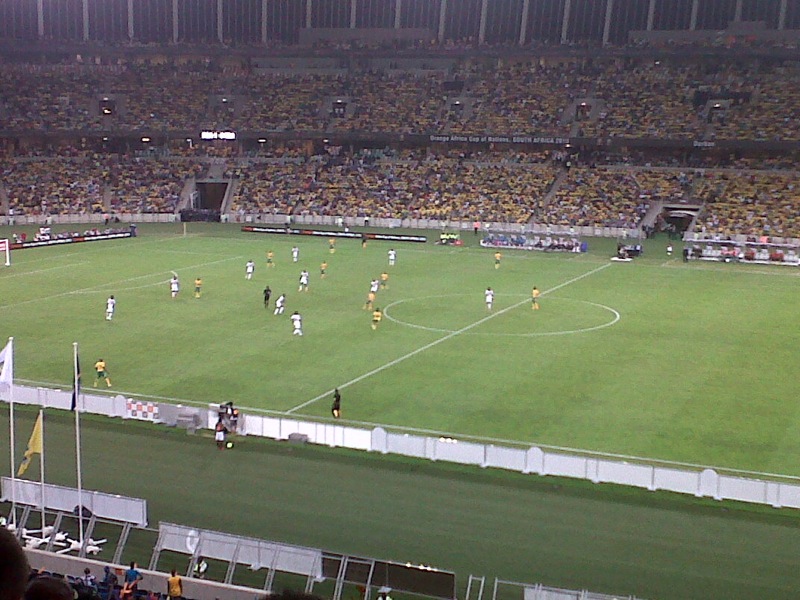
But as I am living in a place where soccer is THE sport, I am willing to embrace the culture and cheer for the home team. As luck would have it, the Africa Cup of Nations (AFCON) tournament is being hosted this year by none other than South Africa (originally scheduled to be in Libya, but that didn’t work out so well), so this past weekend, I had the chance to head to Durban and see Bafana Bafana take on Mali (and lose) in the Quarterfinals.

Since this was my first time in Durban, I wanted a chance to see a few sites, so I left Friday just after teaching and met up with a couple of other volunteers at a small backpackers just outside the downtown area. On my walk to the backpackers from the taxi rank, I passed by Durban High School – and I now know what I want to do when I am done with my service – teach at this school. But as the goal for the weekend was not to find a job, I simply made a mental note and carried on. Friday night gave us a chance to eat out, catch-up, and share stories from the first two weeks of teaching. Saturday was a beautiful day of sightseeing, talking to locals, shopping at some local markets, and even seeing a movie (Les Miserables) at an actual movie theatre! And we still had the game to go! To be honest, I had no idea what to expect, but I told myself I was ready for anything. We headed to the stadium almost two and a half hours early, partly because we wanted to get there before dark, and partly because we were not sure if there was going to be some sort of “pre-game” worth attending. Turns out that South African’s don’t tailgate the way we do in America (or perhaps we just didn’t go to the right places) but it was nice to have a chance to walk around the whole stadium, get our faces painted, buy some souvenirs, and get settled before play began. The vuvuzelas were out in full force from start to finish, but they were of no use in the end. South Africa lost to Mali in a shoot-out and the somber crowd slowly filed out to the streets.

AFCON Quarter-Finals: South Africa v Mali
2 February 2013
Durban, South Africa

I headed home early the next morning, sad to leave the big city, but excited to have had a chance to meet up with others and share in a cultural experience of a different type. Hoping to return to Durban sooner rather than later. And hoping to see another live soccer match before I return to America – definitely a more exciting experience in person on a continent that loves the game the way it was intended to be loved.