Sunday, September 22, 2013

A Fond, Final Farewell


When I arrived last September, I was greeted by a principal who had been head of the school for just over 18 years. Quite an accomplishment indeed. But shortly after my service began at the school, I was surprised to hear that the principal would be leaving at the beginning of the following school year and a new principal would be joining us soon after. Her last day was planned for the 31st of January.

I am not sure why, but it is common practice to have the farewell function (aka goodbye party) for a retiree months and months after s/he has left. The claim that I have heard on more than one occasion is that it takes a bit of time for the school, the teachers, and the parents to save up enough money to throw a proper party. So it was not until this past Thursday, the second to last day of the third term, that our school was able do things up right.

Our freshly painted school.
The tent for the farewell function.
The major planning started a few months back. Teachers and parents had several meetings to discuss the gifts the former principal would be given. After much deliberation, it was decided that the teachers would contribute enough to buy a Laz-Y-Boy recliner and the parents would collect enough to buy a new washing machine. Rather impressive gifts in my opinion. The walls of the school were to be freshly painted so as to look its best. A tent was ordered and a DJ was booked. And of course, the guest of honor was invited to attend. Oddly, it is custom to create a special invitation to invite the honoree to her own function. I thought this bit strange, to be honest, but I was assured it was common practice and it would be an insult if she was not to receive this special notice. I wonder what would have happened if she had responded “no” to being able to attend…

Some of the smaller, but still important details were left until the week of the function. The learners were busy cleaning the classrooms and the school grounds the day before. The teachers planned the menu (although since nearly every Zulu function has nearly an identical menu, that wasn’t that difficult) and did the grocery shopping the day before as well. And at the last minute (and by last minute, I mean the morning of) the program was set and typed up and copied for members of the audience to pass around.

The Girl Guides act as the welcome wagon.
The teachers are busy preparing the meal.
The day of the ceremony started out a bit hectic, but things settled down after the guest of honor arrived. She phoned when she was about 10 minutes away from the school so that she could be properly greeted and welcomed onto the grounds. While she was the principal, she was also a leader of the school’s Girl Guides (like Girl Scouts) and so they played a large part in many aspects of the ceremony that day, starting with her welcome. They actually formed two lines, one on each side of the road, to walk with her car as she neared the school gate. They were singing a typical Girl Guides song to give her a proper greeting. A bit of time was spent taking pictures before she headed into the room where all of the special guests for the day would eventually sit and eat. Not long after her arrival, other guests (mostly friends of the former principal) began to pop in to wish her a happy retirement and see how she was doing. When a fair number of people had arrived, the current principal signaled that it was time to begin. Many, if not most, of the teachers stayed behind in the kitchen to prepare the food for the refreshments, but a few were able to join the crowd of people sitting in the tent to watch the various students speakers and performers pay tribute to the former principal.

Some of the grade 5, 6, and 7 boys
perform at the ceremony.

The principal enjoys her recliner.
The real excitement came when it was time for the gifts. The principal seemed thrilled with the various blankets and other small items given by friends and individual community members. But she was simply ecstatic when she saw the washing machine and the recliner. She sat herself down and spun a round a few times before finally standing back up to give a speech including memories of her time at the school, words of advice for the learners and teachers, and a note of thanks to everyone for making the day such a great success.

For the next day.
Whether we started later than usual or things just took longer than expected, I could not say. But we did not start serving the meal until nearly half past two, which was quite late. People hurried to finish their food and say their goodbyes, and before we knew it there was nothing but piles of dishes left behind. Overall, it was a lovely function to thank the principal for her years and years of service and wish her all the best for a very happy retirement. I hope to have something similar many years down the road.

Sunday, September 15, 2013

Annual National Assessments (ANA)


It is that time of year again. During the second week of September, in schools across South Africa, learners in grades 1-6 and 9 write the national standardized tests, known as the ANAs, in language and maths. In grades 1-3 the language is a learner’s home language (in our school’s case, Zulu), but starting in grade 4, no matter what a learner’s home language, they write an ANA that tests their English skills. Everyone takes a maths ANA as well. Again in grades 1-3, the maths exam is written and to be answered in the learner’s home language, but again, starting in grade 4, everything is done in English. No one likes the ANAs, of course, but standardized tests are an unfortunate way of life at this point, so there is no use grumbling.

I found that much of the process here is nearly identical to America. Lots of paperwork for documenting everything, assigned seats for the learners in the classroom, specific set times when each test is to be administered, instructions to be read aloud and examples to be done together before the test is given, two proctors per room (there was even a “training” session that the principal had to administer to the teachers about how to proctor appropriately), more paperwork for reporting scores and absent students. If there were major differences, I certainly didn’t notice them.

There isn’t much else to say about the test itself. Teachers, principals, and even past volunteers complain about how poorly the test is written, how many mistakes it has, how it doesn’t follow the curriculum, any number of things. But in truth, I didn’t find any of it to be true. I’m not saying it was a great test of knowledge, but every question that was on the test was not only part of the curriculum, but was at an appropriate level of difficulty. I found only one mistake, and it was not really that big of a deal. In general, I actually thought the test was quite fair. It just seems unfair because so many of the learners in the rural areas (our school is no exception) do not seem to be able to pass.

To pass, a learner needs to score a mere 40% (so in the case of grade 5 maths, a learner needs a 24/60). With that in mind, I had two goals: have 17 out of 34 learners pass and have the class average above 40%. Sadly, I failed at both: only 15 individual students passed, and the class average was a 38%. But I was close! And while I know that in a lot of cases, close doesn’t count, I feel like in this case, it does. I was really proud of how well the kids did and I was excited with their progress on a few specific topics, especially multiplication of multi-digit numbers and long division. I am very much hoping that I can follow this group of kids to grade 6 next year and make that goal a reality!

Sunday, September 8, 2013

21st Zulu Birthday Party


This past week, I wasn’t feeling so great, so I was not as excited as I should have been to attend the traditional 21st birthday party of a distant female cousin in the next village over. But it was also one of those events that I felt like I would regret missing. So, I asked two of the other volunteers in my area if they wanted to spend Friday night at my house, wake up on Saturday and attend the party with me and a few members of my host family, stay Saturday night, and then head home on Sunday. Knowing that I would have company would make it a little more manageable, and deep down, we all love a good Zulu function. They said, “Absolutely, we’ll be there.”

The group travels from my village to the next village.
On Friday we met in town and then headed back to my village. And then on Saturday morning, we were ready to go, as requested, at 10am. Which meant that we left my house at 11am to walk over the hill to my uncle’s house, where we waited until about noon to walk with a group of about 40-50 others. The destination was a distant relative’s home the next village over, about a 60-minute walk through the fields. Probably more like a 40-minute walk, but we stopped a few times to do some traditional Zulu chants and the like. All part of the experience.

Like many things in today’s Zulu culture, you can mark your 21st birthday with a traditional or a modern celebration. My host sister, Zama, celebrated her 21st birthday a few years ago with a modern-style function, but yesterday’s event was a strictly traditional ‘umemulo.’ For two days before, all the girls in the village stayed with the birthday girl, basically having a 48-hour party. My host sisters kept telling me that there was lots of dancing, but I have a feeling there were other things involved as well. Then, on the morning of the function, they all went down to the river to bath and dress the birthday girl in a special ‘umhlwehlwe’ (which happens to be the skin of a cow.) A female cow was slaughtered and the skin fashioned into skirt and vest to be worn only at this ceremony, as the outfit will be burned not long after it is over.

Drinking 'umqombothi' before the ceremony.
During the time the girls were at the river, family and other guests (including my friends and I) made their way to the house. Hence the reason we weren’t in any rush to get there. When our group arrived, the guest of honor was not yet present, so we just waited around trying our best to mingle with the hundred or so other people that were waiting with us. The most common activity during this waiting period was drinking ‘umqombothi,’ homemade Zulu beer; not really a big surprise. It wasn’t long before there was a bit of a stir among the crowd, and we realized the birthday girl was making her way into the yard. 

Traditional Zulu dancing at the ceremony.
The rest of the afternoon’s ceremony consisted traditional Zulu dancing and singing. Families formed a few scattered lines of people in a large grassy area and then marched forward as a group with the birthday girl in the lead. On occasion we saw a lone, fairly intoxicated gogo (aka grandmother) dancing off to the side, a bottle of Jameson in hand. But most everyone else seemed to stick to the group effort. The girl was wearing a hat that held money if people handed her cash. For some reason, she was also carrying an umbrella with money taped to it at one point – not sure about the meaning of this, but I can only assume it had something to do with “making it rain,” haha. The traditional Zulu gifts of blankets, basins, and small clothing items, were piled up during the dancing and then whisked away into the family’s abode.

The birthday girl with her money umbrella.

Gogo has her own dance to do.

The tent for special guests.
After the traditional singing and dancing finished, special guests (including my friends and I) were ushered into a large outdoor tent where they were served a traditional Zulu meal. The tent was decorated quite lavishly, and on the table in the front sat an extremely large sheet cake wishing the girl a Happy Birthday. Did I mention that this whole thing does not actually happen on the birthday of the person, or even in the same month? It more or less happens on a date to be determined by the family at some point during the year that the person is 21-years-old. An interesting twist.

The birthday cake.
For our part, we had a great time. The dancing and singing started to get a little repetitive, and after about an hour of it, actually got pretty boring (although gogo certainly spiced things up), but it was a beautiful day, so we enjoyed being outdoors. After we ate, and the celebration moved into the evening hours, we knew it was time for us to go. For starters, people began to take pictures, and they all seemed to want a picture with us, which got a bit annoying. More importantly though, being out in the village after dark, let alone a village that wasn’t any of ours, is not a wise move. Happily, the family had arranged transport vehicles to take us back to my village, unfortunately it did not exactly take us to the door of my house. Luckily, one of the Zulus we were with had a torch (aka a flashlight) to help guide us home from the road. When we got back inside my house, we agreed it was a great event but would have been tough to be at without an American or two as company. It’s a good thing that deep down, we all love a good Zulu function.

Monday, September 2, 2013

One Year Anniversary


Hard to believe, but I have now official been a Peace Corps Volunteer for one full year. I swore in on September 2, 2012 and have been on a wild ride ever since. That is probably a bit of an exaggeration. There are have been ups and downs for sure, but for the most part it has been as expected and has been a great experience. And with less than a year to go, I feel like I have a lot to do in a short amount of time.

No one but me remembered this day as an anniversary, but oddly enough, a bunch of rather incredible things happened that made me think that everyone was secretly celebrating the occasion. I was not at site this past week, as I was spent the last week of August at the Pre-Service Training (PST) for the Education Volunteers that arrived in mid-July (more about that in a minute.) I sort of figured that all of the projects that I had left behind at school would be in ruins upon my return, so I spent the whole walk to school this morning preparing myself to smile and keep calm when I realized that it would take two weeks to get everything back in order. I was so distracted by my own concerns, that I didn’t even notice that in celebration of the first day of spring and/or summer (I wasn’t really sure) none of the kids were wearing their uniforms. Not to mention, that as I was wearing my winter coat, it seemed like an odd day to celebrate the weather warming up.

In any case, I asked my counterpart to be in charge of organizing the Reader of the Day program for the week I was away and the week I was back and I simply assumed that no one would read all week because she would have dropped the ball. Totally wrong! A grade 4 learner was ready to read on Monday morning and there weren’t any problems the rest of the week. After morning assembly, as I made my way to class, the teacher that watched over the grade 5 class during maths time presented me with a completed stack of packets from the previous week. As I glanced through the work I also noticed that a lot of it was correct. Now this probably meant that he had helped a few of them and they had spread the correct answers around, but I’d much rather have the right answers spread around than the wrong ones. Another nice surprise! Finally, before I traveled to PST, I asked the school cleaner and the grade 7 teacher to keep the school store open before school so that the kids still had access to pens and pencils (and so we would keep raising money). After I finished teaching this morning, the school cleaner came to me with just a few leftover pens and more or less the right amount of money based on what was sold. All of these good things sort of made me wonder if I was in the twilight zone! Or if it was a one-year anniversary miracle! I wasn’t even all that annoyed that the computer lab had been cleaned in such a way that nearly everything was unplugged. I just took a bit of time before the second break to plug in the nine computers that I know could be turned on at the same time and left the rest. It was such a good day that I stayed with the grade 6 learners after school for Computer Club and then headed home to get my laundry started. Perhaps not the most glamorous celebration, but one that made me feel as if my first year of work here was starting to make a difference. I couldn’t ask for anything more than that.

Welcome SA28! The PCSA Education Volunteers
serving from July 2013 to September 2015.
It was a nice to be away for the week at PST, as well, although a bit crazy to think that the next group is here and almost ready to swear-in. Before they know it, they will be celebrating their one year anniversary and I will be gone! For their training, two or three current volunteers were invited to be part of the training each week. Peace Corps rented a rather lovely house in what can only be described as a snobby, gated community for us to stay in during the week. Did I mention the house had electricity and way better network coverage than my village? I certainly wasn’t going to complain about that. Our days started around 9:30am, we were driven around everywhere we needed or wanted to go, and got home about 4:30pm. Side note: I nailed the sessions I presented on grammar, vocabulary, and starting a school library ;-) We did have to cook and clean for ourselves, but somehow we managed. And we even got to make cookies a couple of times. It worked out perfectly. Best (and pretty sure only) paid vacation of my life. Definitely going to apply again next year. I better keep practicing my English grammar and vocabulary ;-)

Sunday, August 25, 2013

Burn Baby Burn


I have always been one to enjoy a good bonfire or campfire or fire in the fireplace. I guess I like fire. It has come in handy here on more than a few occasions. Turns out that Zulus also like fire. They use it for disposing of trash, cooking in large pots for village functions, and what I learned most recently, spring cleaning of the yard.

The brush in front of Ncepheni Mountain
during its yearly controlled burn.
As we near the end of winter, the brush across the village and surrounding terrain is very brown and VERY dry. Apparently, this spells trouble. Most Zulus are quite worried that everything is going to go up in flames at any minute; so to prevent this disaster, they just burn it themselves. For a greater portion of the last month, I have seen these controlled burns in the distance. One evening, there was a large area on the backside of a nearby mountain being burned and it lit up the mountain in an eerie silhouette. I figured it was only a matter of time before we would take our turn and burn everything around our yard.


My host sister Niki makes sure that the small flames
are put out when the area is done with the burn.
I’m not really sure how it was decided what day we would light the grass ablaze, but late one afternoon this past week I saw some neighbors, surrounded by a fairly large group of kids from the village, lighting a match and waving on the flames. The next thing I knew, I heard a “crackle, crackle” and I realized my family was outside doing the same. The grass inside the fence is actually not to be touched; it is just all the grass that is in between yards and properties, mostly along dirt roads and paths. I also learned that it is better to complete this task at dusk or at night because it is easier to see the flames and less likely they will get out of control. The adults walked around with small buckets of water, sprinkling the grass and fence posts to create something of a boundary to contain the fire. Most of the kids held large, leafy branches to swat the flames down or out when they had burned the appropriate area. The smoke and ash that got caught in the wind was pretty intense at times, and I definitely found myself a little too close to the action once or twice. The whole process was somewhat amazing. Although, in the back of my mind I wondered how many times things didn’t go quite as planned. Luckily, that was not the case this time around. Whether or not there is any real reason to do this, I really can’t say. The Zulus believe it is absolutely necessary, so there’s no stopping them. I can’t say this for sure, but I don’t necessarily think the process is good for the soil if it is done year after year after year. But again, that is irrelevant. What is most important is that if someone carelessly flicks a lit cigarette butt on the ground now, there is a much smaller chance that the whole village will burn down. Which according to my host sister is the justification for all this burning. Very interesting…


Saturday, August 24, 2013

After School Clubs

After reading a few of these blog posts, you may or may not have notices that things here have a tendency to move slowly. To say that no one is ever in a rush to get anything done would be an understatement. My arrival was not suddenly going to change that, either. So, although it seems really pathetic, after two and a half terms, I am proud to announce that I now have two after school clubs up and running and meeting on a regular basis. Truthfully, I think this is nothing short of a miracle.

Grade 6 doing keyboarding work in the Computer Lab.
The Computer Club meets on Mondays, Tuesdays, and Wednesdays from 2:15 – 3:00pm.  Monday is only for grade 6, Tuesday is only for grade 5, and Wednesday is only for grade 7. Ten kids can come at a time because that is how many computers can be turned on at once. There is something wrong with the wiring or a circuit somewhere so if you turn on more than ten computers the electricity in the whole school shuts off. Unfortunate, I know, but no matter; ten is better than zero, and if I waited until all eighteen could be used at once, this paragraph would never be written.

Grade 5 watching videos on Encarta for Kids.
The club starts off with a little lesson in which I show them a new “skill,” like opening and saving a Word document or moving something to the trash. After they have fiddled around with that for a few minutes, I make them open a program called Rapid Typing (which I got from the Peace Corps) and complete one of the exercises. I’m not trying to turn them into typists, I’m just trying to familiarize them with where the letters are on the keyboard, because seriously, it can take five minutes to type their own name. Once they have finished the exercise, they are free to use the computer however they would like. Most of them watch the short video clips or play the little games that can be found in Encarta for Kids. Occasionally one of them will try to play Solitaire or Pinball or a geography game. Since the computers don’t have access to the internet, this is about as good as it gets; but for kids that can barely maneuver a mouse correctly, it’s a great place to start.

Happily working on a puzzle.
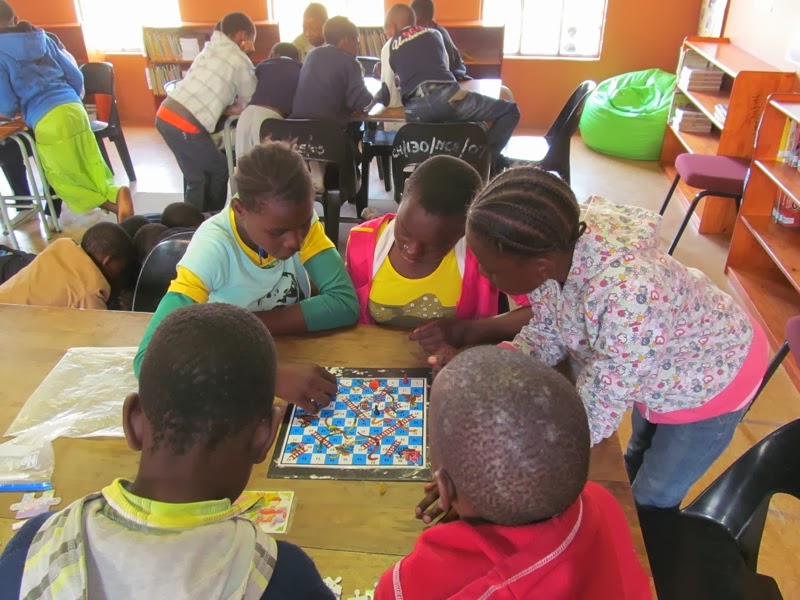
The Games and Puzzles Club meets on Thursdays (also from 2:15-3:00pm) or on Friday during school cleaning time from (12:00-1:00pm) but since we are in the library about 30 students can come to participate, and I always end up letting more in because they seem perfectly happy to sit on the floor. I have big plans for this club in the next couple of months – perhaps not the most realistic plans, but I’m going to give it a try. 


Word search time.
For now, I start things off by giving teams of three kids a word search and the first team that correctly completes it wins a small prize (compliments of my American family and friends). After that, I just let the kids play the games or work on the puzzles that we already have in the library (also generously donated by Americans.) I usually spend some time working with a small group of kids who want to try the Rubik’s Cube. I have one grade 6 boy that can solve the first layer, which I think is amazing. The rest of them just sort of fiddle around with it, but I’m pretending like it is making them think. My hope is that I can eventually have weeks where we make games (the previous volunteer left behind a pretty cool book published by PC Namibia with games that you can make using essentially trash commonly found in rural areas).  Then the kids can take these games home and play them with their families.
Snakes and Ladders is a school favourite.
I also want to have weeks where we work on “projects.” First up is to make an aquarium. This has been started, but as with everything here, isn’t moving as fast as I had hoped. Normal. The kids have colored and cut out pictures of sea life and next we are going to hang them in the frame of an old desk covered with blue paper so it looks like a fish tank. It’s hard to describe, but when it eventually gets done, I’ll post a picture. I also really want to have them make a paper mache solar system to hang from the ceiling of the library. This may be a bit ambitious, but if it happens, you will all be the first to know.

So, that’s my new after school routine. It’s funny because I’m still finished by 3pm, so it doesn’t really feel like I’m staying extra late, but the place is a ghost town when I’m done. Clearly a sign that it will absolutely not continue when I’m gone, but I’ve given up on that. If I only did things that I was sure would continue when I left, I’d do nothing but twiddle my thumbs all day. Not really my style.

Monday, August 19, 2013

This Old House: Zululand


Front view of the main family house.
The compound where I live is pretty typical of a rural South African family. The main family house has three rooms: kitchen, living room, and one bedroom. Like most houses that I know in America, there is the formal front door and then the back door that everyone really uses. There are two one-room houses behind the main family house: one serves as bedroom (mostly in the summer when it is warm enough), and the second as a second kitchen / storage room. It is used as a kitchen when mama is making traditional Zulu beer or helping someone in the village cook for a large function. On one side of the main family house is a one-room house dedicated to the ancestors. Anything for ceremonies is stored here (like traditional clothes and weapons), as well as heirlooms from deceased relatives. It isn’t supposed to be used for anything else, but if you have a big family and perhaps are short some space (because you are subletting to an American for several years), it’s difficult to keep it empty.
The back door where visitors come and go.
I know that my family, for example, also stores maize in the house after the harvesting season. On the other side of the main family house is a two-room house built for my half-brother Musa (son of the first wife of my deceased host father). It is his whether her moves back to the area or not, and it is where he stays when he occasionally comes to visit. If there were more sons, they would all have houses built for them as well, but since every other child born to my host father was a female, only one extra house needed to be built. Lastly there is my rondavel, which I have been assured, was empty before I and the previous volunteer moved in. In fact, my host sister told me that originally the family was asked if they would store several hundred, school textbooks while the secondary school underwent major renovations. Then, when the school was told that they would be hosting a volunteer for two-years, the principal asked if the space could house a person rather than some old, dusty books. Clearly it worked out well, but I have to laugh at the idea that one day you think some books are being delivered and the next thing you know an American shows up.

The back houses: on the left a bedroom, on the right a kitchen.

One of the uses of the outside kitchen is for brewing
traditional Zulu beer: umqombothi

The house of the ancestors.

My host brother Musa's house, should he ever choose to live there.

Home Sweet Home!

A new addition being added on to the main family house!
In the last five to six weeks, the main family house has gotten a major upgrade! Another bedroom is being built onto the back of the house. Before I left for Namibia, mama had two men come to make the concrete blocks. Sand and concrete powder was delivered in big piles and then the men came with a mold to form the blocks. They were laid out in the garden to harden over the course of several weeks. The actual construction began while I was away on vacation and has continued slowly but surely since I returned. There doesn’t seem to be a regular construction schedule, the two guys just show up when they can, but this past week the roof went up and things seem to be closer to the finish than to the start, so that is a good sign. The inside walls still need to be plastered with something that makes them smooth, and the floor inside still needs to be laid.
A door to the new room was carved out in the kitchen.
I’m sure there are
other things as well, but I can only see the most obvious things that need to be done. All in all, it is good news for my host sisters, as it will mean the six of them no longer need to share one bedroom during the winter months when they are all home and it is too cold to sleep in the outside house. And it was exciting to see some home-remodeling, Zulu-style.