Monday, August 12, 2013

Women's Day Weekend


Yay for three-day weekends!

This past Friday was Women’s Day – a national public holiday here in South Africa that began in 1994 and celebrates the Women’s March of 1956 when somewhere between ten and twenty thousand women marched in Pretoria to protest the proposed “pass laws.” I’m not going to write much more about the historical aspects because I was neither there nor can I find a source reliable enough to quote on the details of the march. All I can say with certainty is that every year on the 9th of August, learners and teachers don’t have to attend school.

So, since there was no school on Friday, it was the perfect time to take a quick trip to St. Lucia, a fairly low-key tourist town on the coast. It’s a bit tricky to make it there in one day using public transportation, so I decided to leave after school on Thursday and go just halfway. There are a few volunteers that live between here and there, so I was able to find a place to stay on Thursday night and finish the journey on Friday morning. And as a surprise added bonus, we even ended school early on Thursday. Supposedly there were schools in the area that thought Thursday was a day off as well (I don’t even know how that is possible) so our school administrators decided that we would start cleaning at 11am and close school at noon. You certainly weren’t going to hear any arguments from me; I’ve learned to accept that this is how things work. Now, I’m simply grateful for the positives rather than constantly pointing out that the less time the kids are in school, the less likely they are to do well on the National Assessments. The teachers don’t seem to believe there is a correlation there, so it’s useless to argue that point.

A popular fishing site in St Lucia over Women's Day Weekend.
Instead, I took advantage of the extra time to enjoy a break from village life. After spending Thursday night in Richard’s Bay, I met up with another volunteer in Mtubatuba on Friday morning, and we were in St. Lucia by early Friday afternoon. We didn’t have any plans other than to enjoy the outdoors and eat as many meals as we could. While we were not blessed with sun-filled days, it didn’t rain too terribly, and we were able to get out and about and see a few sites. On our trip down to the beach, we saw residents and visitors fishing in the ocean. As we walked along the river that leads to the Lake St. Lucia, we spotted a hippo coming onto the shore to dry off. And while winding our way through the nature trails, we were able to photograph a few of the unique and colorful birds that are native to the region. We enjoyed burgers, fish & chips, pizza, and curry while dining at an assortment of restaurants throughout the town, and back at the bed and breakfast, we even had a chance to watch some TV. Neither of us has electricity at our sites, so this was a truly exciting experience!

A happy hippo takes a look around.


One of the many colorful birds that can be all around St Lucia.

When Sunday morning came, I was sad to go, but really happy I had the chance to visit one of my favorite places in South Africa. Not sure when I’ll be back next, but it will certainly be before September 2014. Can’t wait.


Monday, August 5, 2013

Back at Square One


Last week was a frustrating one. I’ve heard from volunteers and PC staff alike that at about the one-year mark, you go through a slump. I wasn’t necessarily anticipating this, but it seems to have happened. Perhaps it is coincidence, or perhaps it is that I am having a harder time coping with setbacks because of the timing. Either way, this week was not easy, and in many ways, I feel like I’m back at square one.

Monday’s frustration was a result of a visit from the DOE District Office. The week before, I attended a meeting with our district representative where I was told that the Provincial Office is sponsoring a “pilot project” where they monitor, evaluate, and possibly award schools that have established and use a school library. This district representative told us that we would be given “support” in the coming weeks to enhance and build on what we have started. The first of these “supportive” visits came on Monday.

The three representatives from the district arrived just past 11am, which would have been the perfect time for them to see the library in action, as grade 6 has library class from 11am-12pm on Mondays. But instead, class was canceled and the students never left their classroom because the representatives said they wanted to see the library “undisturbed.” This really should have been my first clue.

After a few minutes of the standard greetings, one of the representatives asked to see our Accession Register while another started to look through the books on the shelves. In a matter a seconds, we were told that our numbering and labeling system did not match the official system and the books would need to be “reprocessed.” When I pointed out that their official labeling system would not allow for us to distinguish between duplicate copies of a book (because all the copies would have the same spine label and we would not know which one was missing should one go missing), one of the representatives responded simply by stating that we should not be allowing books to be checked-out since we did not have a full-time librarian to properly run the library. When I asked how our school should go about applying for a full-time librarian, if that was the case, the same representative responded by saying “there are no postings available.” I laughed out loud. Just to make sure I understood correctly, I said, “So the DOE expects schools to have functioning libraries, BUT they can only be functioning if there is a full-time librarian, BUT we cannot have a full-time librarian because the DOE has no posts available.” The response, “That is correct.” Way to be supportive! Instead of saying “great work” for figuring out how to overcome the obstacles of no resources or help, they basically came to say “you’re doing it wrong.” They cared only about appearances and nothing of the true work that was being done by the teachers and learners. One of the men that came from what I was told was the “resource center” looked through every book on every shelf without saying a word. He never said what he was looking for or why this was such an important task. None of the three visitors asked how the library was used. They never asked how frequently learners came or what programs were established to promote reading. Their concerns were with the book labels and recordkeeping. And in that regard, we were told we needed to go back and “reprocess” things. Back at square one.

So that’s how the week got started. The other teachers did not take it as hard as I did. Possibly because they are so used to the way the DOE functions, that they recognized this as par for the course. Or possibly because none of them has put as much work into the library as I have. I don’t really know. But neither I, or any other teacher at the school, has any intention of starting this task any time soon, so it is hard to say how it will work out in the end. But it was not really the news I was expecting to hear.

Friday was when I got my next “start over” notice.

The first two weeks of the term, I was teaching fractions in grade 5. It was new material as far as I could tell, and it was not going great, but they were progressing steadily. I didn’t want to immediately give a test on only fractions, so I decided to do a brief review of all the whole number concepts that we had studied in terms 1 and 2 and then give a formal assessment that covered all that material. As an added bonus, it also happens to be what the curriculum says. I expected them to be rusty and need reminding, but nothing could have prepared me for how little they seemed to remember. And then it dawned on me – we had a THREE-WEEK vacation between terms 2 and 3. I think a three-week school holiday would spell disaster in my American classroom. Here in a rural school, it is nothing short of catastrophic. It’s as if terms 1 and 2 never even happened. It really felt like starting a new school year with these concepts. Virtually nothing seemed to have moved from their short-term to long-term memory. There were two or three learners who had relatively few problems, but I think that it was review for them when we did it earlier in the year as well. The information had already transferred to their long-term memory. For the rest, we needed to practice as much now as we did several months back, and unfortunately, there was little time for that. I reviewed the big things (addition with carrying, subtraction with borrowing, and rounding) as much as I could and gave the test on Friday. Not exactly the results I was hoping for. In the week we spent reviewing the whole number concepts, many of them forgot the few new fraction concepts, and it became apparent that most of the whole number concepts were still shaky for quite a few. I finished marking the papers and then put them aside. Back at square one.

I’ll think of a plan for re-teaching and reviewing soon, but the rest of the weekend I needed to spend time reminding myself that it is not a waste of my time to be here. Gains are small and often unnoticeable or immeasurable. But they are there. And I’ll get back to square two soon enough.


Monday, July 29, 2013

Christmas in July


In one of the emails that I sent to family and friends, I requested pens, pencils, pencil sharpeners, rulers, and other small school supplies to sell at our “school store.” The profits from this store will be used to purchase new books, magazines, and newspapers for the school library. It is taking a little time to reach our goal of R2000, but we are getting there slowly but surely.

As I recall, my email went out shortly before I left for my four-week, winter break getaway, so I figured upon my return there would most likely be a couple of envelopes with some supplies to get started. To my surprise, there were large packages from nine different people, filled with hundreds of pencils, pens, sharpeners, stickers, and other treats, waiting for me at the post office when I finally stopped by my first weekend home. Not to mention the extra suitcase my sister brought with her when she came to visit, stuffed with gifts from my family back home. It was amazing! (Actually, the post office was a bit annoyed. When the woman saw me come to the window, she said “Which one of you is Monica Sislak?” I replied, “I am.” She made a disgusted face and said, “Eish, your packages are piling up here!” I just laughed, handed over my candy bar and said “thanks.” It was almost extra awesome to know that the post office was inconvenienced.) Anyway, a few more packages arrived the following week and I picked them up this past weekend. All in all, a tremendous outpouring of generosity from those back home to help the kids here, in more ways than one.

Gifts and supplies from my family and friends.
The store is now stocked! Which is not to say anything that arrives in the future will be worthless or unused, but it is nice to have a selection to put out for the kids. The older learners appreciate buying blue or red pens that actually write and don’t break after just a few days. And the younger learners’ eyes really do light up when they come in to buy a pencil. We charge R1 (the equivalent of about $0.10 these days) for a pencil, which is the same price they would pay in town, but it is so much more exciting to pick out a pencil that is neon pink or has colorful butterflies or soccer balls printed on it.

I have used the opportunity to teach everyone, even the learners in grade 1, how to say “I would like to buy a pencil” in English. And of course there are countless math lessons when a learner comes to buy more than one item or pays and expects change. They have to tell me how much change they should receive and why. It’s true that some of these transactions become rather lengthy, but who cares? This is Africa! Time has a different meaning here (see my March 11 post for further insight.)

In any event, THANK YOU, to all those who have sent packages: the ones that have made it and the ones that are still “in the mail.” Your gifts are most certainly appreciated and being put to immediate good use. When the new books arrive for the library, pictures will be sure to follow!


Monday, July 22, 2013

A Tradition Zulu Ceremony: Abayeni


Just a few days after I arrived home from my winter break travels, my host sister asked me if I would be home the upcoming Saturday. As I had just spent nearly four weeks away, I said that I couldn’t imagine being anywhere else. She smiled and said that was good news, because there would be a traditional pre-wedding ceremony, called Abayeni, in the village on the 20th of July! The hosting family would be the Ndlovu’s, who live just around the corner. The eldest son in the family owns the shop that I frequent to buy bread, cookies, and beans, and it is his sister that would be getting married. Since it is the bride’s family that plays host to this traditional ceremony, it was good news indeed. After attending my host family’s reunion function, I was hoping that there would be more traditional ceremonies on the horizon.

Ready for the Abayeni
.
My host mom suggested I borrow some traditional attire to wear for the day. Not sure if I pulled it off, but everyone kept telling me I looked wonderful. You can judge for yourself.

It was a glorious Saturday, and things got started around 10:30am with the presentation of gifts to the women of the groom’s family. The groom’s mother received the vast majority of the items, including large amounts of cash, paraffin (oil used in lamps and small stoves), sugar and maize, washbasins, and blankets. Blankets are a BIG thing. Everyone gets a blanket. Seriously, nearly every woman that was related to the groom sat down on the ground and received a blanket by having it wrapped around her. The quality of the blanket was determined in part by her age and how closely related she was, but I am pretty sure that I counted nearly 40 blankets in the original pile to be distributed.

Gifts for the groom's family, given mostly to his
mother in the pink scarf and white blanket.
After all the blankets and other gifts were packed up, the bride’s family took their turn to receive gifts from the groom’s family, with a slightly different twist. First the youngest brother of the bride received a small handful of gifts that he was allowed to request in advance. In this case, that included a new pair of rain boots, an umbrella, and some liquor. Then the oldest brother of the bride (and host in this case) took center stage to receive a few gifts that he also requested in advance. His list included a blanket and new sneakers. It is my understanding that the bride’s father would also have received several gifts at this time, but as he was no longer alive, it was not a part of this family’s ceremony. Then it was the bride herself that began to receive gifts, mostly in the form of cash, and oddly either tucked into or pinned onto a very large (and rather heavy) hat that she wore throughout the ceremony. The bride was accompanied by two female attendants throughout the day, although their purpose seemed mostly ceremonial as they didn’t do anything like write down who gave what for thank you card purposes. I didn’t ask, but I don’t think that’s a part of the culture to be honest.

The youngest brother of the bride
received his requested gifts.

The oldest brother of the bride with his new blanket
and sneakers. He was also the host of the ceremony.

The bride-to-be with her valuable hat.

More members of the family and community generously
give to the bride by pinning the money to her hat. 

When the bride was finished collecting, the first meal was served. Family and friends of the bride scurried around delivering plates filled with rice, chicken, beef, butternut, coleslaw, beetroot, and potato salads along with glasses and large bottles of cold drink (aka soda) to everyone as they sat outside. About twenty minutes after a plate with food was handed to me, a young girl came to collect it and take it for cleaning. Lucky I was done eating :-)

The family of the bride and others from the village
perform traditional dancing after the meal.
The rest of the day involved quite a few costumes and a whole lot of dancing. Sort of like a version of the movie “Step Up.” This one could have been subtitled “Zululand.” Since the bride’s family hosted the ceremony, people from all around the village were a part of her dance company. While the groom’s family sat on one side of the yard, the bride’s family started on the other side dancing towards them and then back. Sometimes just the men, carrying sticks and shields. Sometimes just the women, topless but with colorful skirts. Sometimes everyone. The music, mostly chanting, was sung by nearly everyone in attendance, while whistles blew to signal the time for high kicks and clapping. It was quite a performance by the village. When their turn was finally over (and I have no idea how that was determined) the groom’s family took their turn doing mostly the same thing. Their dance troop was a bit smaller since it was not supplemented by the village at-large, but what they lacked in numbers they made up for in style. Most of the men were wearing matching bright green, satin, button down shirts with neon orange crosses on the back. If there was a meaning to these costumes, it was lost on me, but they certainly looked beautiful.

The family of the groom performed several dances
wearing these brightly colored shirts.
After some amount of time of back and forth chanting and dancing, the bride’s oldest brother declared it was time for the second meal. At that point, everyone who was not actually family was expected to return to their homes, while the two families celebrated and dined inside a large tent decorated to the max with linens, lights (run on a generator) and fine china. There was also a DJ playing a pretty intense mix of Zulu and American music. I didn’t stay, but as I could see the whole thing from my front stoop, I had no problem hearing the music as well. I was sort of expecting it to be a party into the wee hours of the night, but the music shut down at about 7pm. Practically speaking, it’s not easy to walk home in the dark, and that is exactly what most of the family who lived elsewhere in the village needed to do.

Unfortunately I will not be invited to attend the actual wedding ceremony as that takes place at the groom’s family’s home, and in this case, in a totally different village. Since my host family is not related to the Ndlovu’s (we are part of the Ngobese family), it looks like I’ll have to wait a little longer before I attend a traditional Zulu wedding. Hopefully there will be one sometime in the next year!


Friday, July 19, 2013

Namibia Highlights Part 3: Swakopmund


Our third and final Namibian destination was to the coastal town of Swakopmund, known for its German style architecture and plethora of bakeries. As it was winter, the beach was not a main attraction for us, which was no problem because there were plenty of other things to see and do.

Sunset at Swakopmund.
We took a bus from Windhoek to Swakopmund that arrived in the late afternoon on the 5th of July. It was actually a rather exhausting ride (and was several hours late) so the only thing we did that evening was walk down to the water and take a few pictures of the sun set over the Atlantic, not something I saw on the east coast of the US.


View of the town and the dunes from the Swakopmund Pier.
The next morning we set out to explore the town – right after we stopped by the post office to buy some stamps and mail a few postcards. After our errands were done, we headed to the water and walked out onto the pier to get a great view of the town and the dunes. We also decided to make a short visit to the National Marine Aquarium of Namibia. It was not very big, but it had a few very creative exhibits, and I especially liked watching the stingrays swim right up to the edge of the tank and nearly hop out over the glass. It seems unlikely that they will ever be successful, but I guess you never know. After a short lunch (and pastry) stop, we headed back to the backpackers to get ready to meet our guide for our afternoon tour.

My sister poses with a 1500 year old welwitschia plant,
the national plant of Namibia.
Since my sister is a biologist, she was very excited to see the famed Welwitschia plant of Namibia. It is sort of a bizarre and somewhat unimpressive looking plant that it thought to be almost prehistoric in nature and can live to be thousands of years old. It is actually more a tree than a plant, it only ever grows two leaves its entire life (although the leaves split so it appears as though there are more) and there are separate male and female plants that depend on insects and other natural occurrences to reproduce. There wasn’t too much about it that I found interesting, but it was cool to see as one of many very unique sights in the Namib Desert. I personally enjoyed the “moonscape” so named because the pictures brought back from the moon looked remarkably similar to some of the rock landscape of the desert. It was especially nice that our tour ended as the sun was setting and we were able to see another beautiful African sun set over the rocks and dunes in the area.

The "moonscape" of the Namib Desert surrounding Swakopmund.

It was almost impossible to believe, but our time in Namibia was coming rapidly to a close, as the next morning we were headed back to Windhoek by bus, and then the morning after that we had an early plane to catch back to South Africa. When we arrived back in Windhoek the afternoon of the 7th of July, we still had time to make a quick trip to the local craft market to pick up some last minute souvenirs before it closed. After that, we headed to Joe’s Beerhouse (a can’t miss eatery from all the things we read) for an early dinner because our taxi to the airport was leaving the next morning at 4:30am. Probably not the best planning, but we survived to tell the tale.

And that was it! Overall, a fantastic trip. It was great to see my sister, although I can’t believe that she is already back in the US after the months and months of planning that was done before her arrival. I can’t say enough good things about the places we stayed and the people we met. I would seriously consider returning for another visit to see a few other places around the country, although I wouldn’t mind going to all these same destinations again too :-)


Wednesday, July 17, 2013

Namibia Highlights Part 2: Sossusvlei


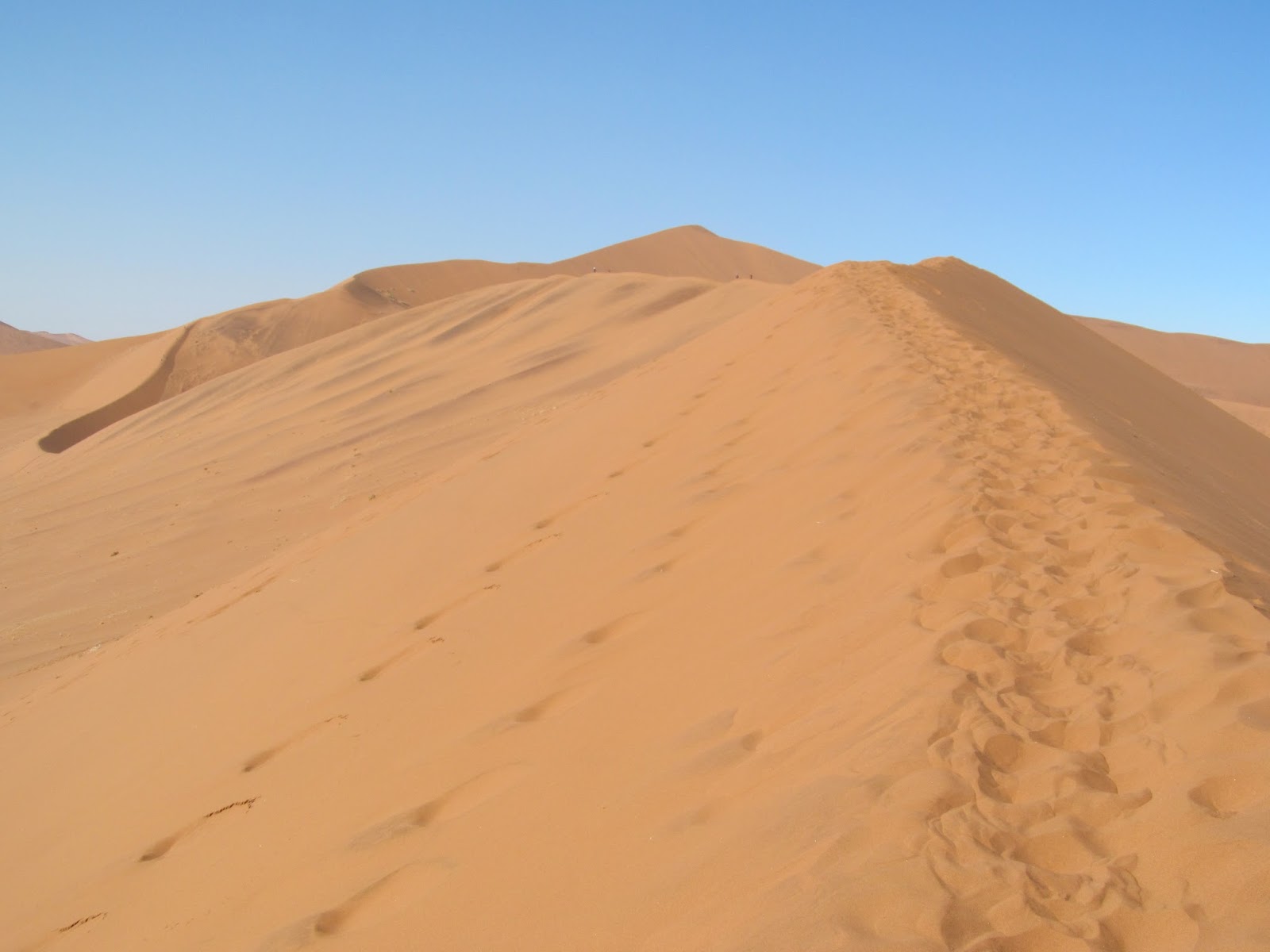
My main motivation for visiting Namibia was to see the world famous sand dunes of the Namib Desert, so visiting Sossusvlei was my top priority. I don’t think I could have asked for a more perfect three days. The weather was gorgeous, the crowds were minimal, and the climbs up the dunes were stunning. In my opinion, no picture will ever truly capture the magnificence of the dunes, but I, like everyone else, certainly gave it a try.

The drive from Windoek south to the dunes wasn’t quite as long as the drive north to Etosha, but my sister and I still got an early start on the morning of July 2nd. As we made our way, I took note of just how remote we were. For miles and miles (or kilometers and kilometers) there was simply nothing on either side of the road except a grassy plain with a mountainous backdrop. Oddly enough, wire fences were posted on both sides of the road, and every so often we would see grazing cattle, so someone owned the land. But where they lived was a mystery to us. There was also a distinct lack of cars traveling in either direction. It became obvious how vast and sparsely populated the country is – even during peak tourist season.

Most of the dunes are in an area called Sossusvlei, which is located inside Namib-Naukluft Park. One of the most popular activities for visitors is to climb a dune (Dune 45) and watch the sun rise over the desert from atop the sand. This is really only possible if you camp inside the park, because the gates don’t even open until sunrise. With this in mind, the best (budget) option is to stay at Sesriem Rest Camp, which is just inside the park gates and a short drive away from Sossusvlei and all the dunes. As I was definitely interested in the “sunrise climb” it only made sense for us to head to Sesriem and step up camp.

View of the Namib Desert from Elim Dune in Sesriem.
We arrived in the late afternoon with enough time to hike up the nearby Elim Dune and watch the sunset: a truly beautiful sight. I felt as though I could actually see the color of the sand changing from bright orange to deep red as the sun went down behind the dune. There’s a funny thing about this dune. When you look up, you think, “I’m almost to the top”. But when you get to that point, there is another hump in front of you. At some point you just have to stop and enjoy the view because it’s perfectly fine from nearly any height.

My sister and I at sunrise at the top of Dune 45 in Sossusvlei.
The next morning we got a VERY early start because it was time for our big sunrise climb. We got to Dune 45 and started the trek up with a number of others. I’m not a big fan of walking in sand – even when it is flat on the beach, so I took the climb up the dune at a pretty slow pace. It was hard! But no matter, I got there eventually, and in plenty of time to see the sunrise. When nature’s show was over, my sister and I made our way back down the dune and had some breakfast before heading off to see the rest of the area. You can only drive up until a certain point, and then if you want to go any further (which you do so that you can see the other parts of the Sossusvlei area) you either have to walk about 5km through the desert or take a 4x4 shuttle provided by the park. We walked since it was a beautiful day.
Sunrise on Dune 45 in Sossusvlei.

The "Big Daddy" in Sossusvlei, the world's largest sand dune.
While on the short hike, we saw a few springbok as well as some unique desert plants. The goal was to get to the “Big Daddy,” said to be the largest sand dune in the world. I’m not really sure who measures these things, but even if it isn’t the biggest, it is a pretty big pile of sand. My sister took the challenge of climbing to the top. I enjoyed the view from about halfway, which was still quite nice. We met at the bottom, in the area known as Deadvlei, home to the 900 year-old camel thorn trees. The trees are actually dead, but haven’t decomposed because it is simply to dry. Instead, the have been scorched black and hardened by the sun to make for a beautiful sight with the white clay below them and the red sand behind them. After taking as many pictures as possible, we headed back to the campsite for lunch. It was pretty incredible to think that we did all of that in just one morning!

The 900 year old trees at Deadvlei.

The rest of the afternoon we spent relaxing before making an evening journey to the nearby Sesriem Canyon. Not really much to see, except for one fairly bizarre sight. At one end of the canyon, there is a small pond with fish. The source of the water is deep in the ground, but the original source of the fish was a bit unclear. Leftovers from the Tsauchab River which formed the canyon, I guess. It didn’t seem that remarkable until you consider that the area only received about a millimeter of rain last year. Apparently that was all that was needed for the fish to keep swimming about. 

The small town of Solitaire, Namibia with its world famous apple pie!
That's right, you're looking at the whole town.
After a good night sleep, we headed back to Windhoek the next day, making a short stop in the small settlement of Solitaire. Literally the town is gas station, a post office, a small store, a campsite, a motel, and a bakery, but that is all it needed to become world famous. Mostly the fame comes from the apple pie/strudel sold at the bakery (which was delicious) but also from the fact that it is one of the only places to stop between the dunes and Windhoek. We arrived back at the backpackers by late afternoon, with enough time to grab some dinner before turning in again for the night. A successful second leg of our adventure!


Monday, July 15, 2013

Namibia Highlights Part 1: Etosha


One of the great joys of being a PCV is having the opportunity to travel, both in-country and to neighboring states. While there are countless amazing places to visit in South Africa, Namibia is a country that I have always wanted to see. (Truth be told, I was hoping to be placed in Namibia when I applied to be a volunteer.) But that was not to be, so planning a trip during my winter school holiday would have to do. This same break also turned out to be the only time that my sister Christine would be able to come and visit me, so it worked out that I would have an easy-going traveling companion for the adventure. Because of both time and money, we had to limit our visit to three places in about ten days, and while I would have loved to stay longer and see more, I think we made great choices and saw several true highlights of the country.

Friendly giraffe.
After flying to Windhoek from Joburg and spending a day sight-seeing there (which is about all you really need), we headed north to Etosha National Park for three days and two nights of game drives and camping. On the way, we made a short stop in the very small town of Okahandja to visit the wood-carving and craft stalls that sell traditional Namibian souvenirs. We were not necessarily in a buying mood, so we took some time to browse, but left empty-handed. Because the journey from Windhoek is rather lengthy, when we arrived in the park, we didn’t have much time to drive around and see animals that evening. But on the short trip we made to our campsite at Halali, we saw springbok, zebras, elephants, giraffes, and a rather stressed-out rhino. 
Grazing springbok.
After setting up our tent and having something to eat, it was completely dark – making it the perfect time to head down the flood-lit water hole, a true highlight of the campgrounds in Etosha. To our amazement, there were half a dozen rhinos gathered around, sipping water and nibbling the dry brush. Of course, I failed to have my camera, and didn’t realize until a little later how rare of a treat this was. Ah well, I guess it means I’ll have to go back someday :-)

My sister and I at the Etosha Pan.
The next morning we woke up early and headed to the Etosha Pan to see the vast expanse of whiteness. It had sort of an eerie feel to it as you looked onto the horizon and really saw nothing but dry, salty earth.
After our visit to the pan, we didn’t need to drive too much further before we spotted a herd of elephants, babies included. Shortly after that, we spied a cheetah sitting under a lone acacia tree, scanning the horizon for something to eat. After about ten minutes, the cheetah was on the move, and we realized that there were three cubs trailing behind her. We were only able to see the cubs with a pair of binoculars, but it was fun to watch them bounce along behind their mother. Across the plain, springbok, zebras, wildebeest, and oryx were plentiful for viewing, both for us and for the lions! One was seen crouching beneath the brush, poised to strike at any moment. But as the lioness had more patience than we did, we carried on to our next campsite, Namutoni, before her hunt got any more interesting.

Elephant family.

Cheetah in the distance.

The plain of Etosha National Park.

Zebra family.
After setting up camp and resting for a bit, we went out again in the last afternoon, cameras in hand. We were not disappointed. The elephants, springbok, zebras, and giraffes were plentiful and feeling particularly photogenic as they seemed to be poised at the side of the road for us to photograph. The birding also started to heat up as we spotted several unusual species found only in Southern Africa. As we headed back to the campsite we were fortunate enough to see a young male lion on the move. He met up with several lionesses relaxing in the grass, perhaps having just finished a meal. And before we arrived back at camp we were treated to a beautiful African sunset, complete with giraffes.

Lion on the move.

Lilac-breasted Roller.

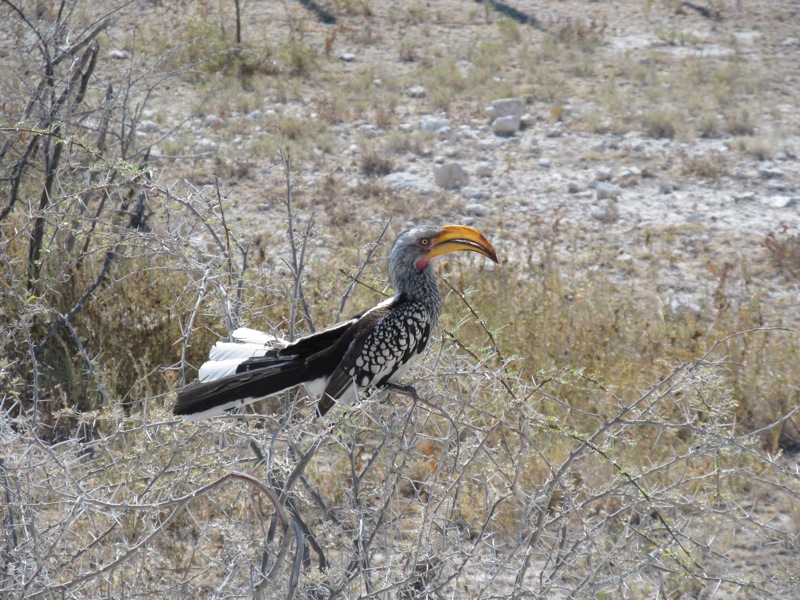
Yellow-billed Hornbill.

Great sunset.


Lions relaxing in the sun.
Our last morning in the park was reserved for a drive to see the dik-dik, the smallest antelope in the world (I think.) On the way, we were stunned to see a male and female lion lounging just a few meters from the side of the road, in no hurry to go anywhere. After taking a few (hundred) photos, we were on our way to the special area of Etosha were the dik-diks tend to be found. Although they are small, they are apparently rather social, as they were easy to spot trotting along in the bush. It was a fun surprise to see something so unique.


Dik-dik.

And then we were on our way back to Windhoek! Although it was short, I think our Etosha visit was perfect – and I have the picture to prove it!